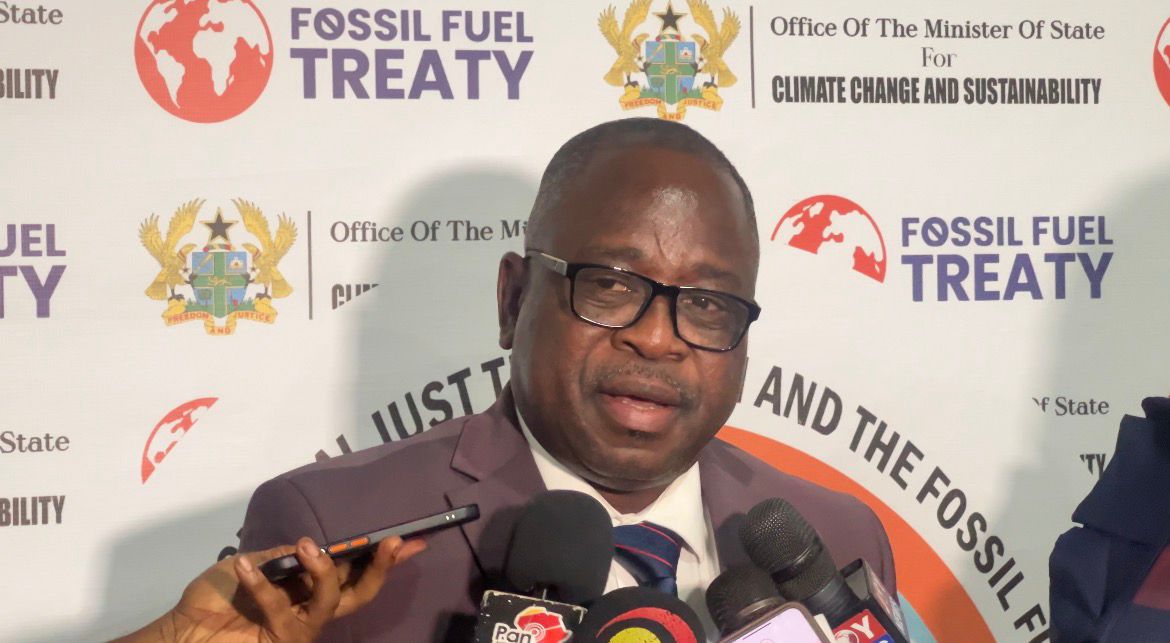
The Office of the Minister of State for Climate Change and Sustainability, in collaboration with the Fossil Fuel Treaty Initiative, has held a high-level dialogue on global energy transitions and Ghana’s role in the Fossil Fuel Treaty process.
The forum examined how Ghana can shape, and benefit from emerging global frameworks for a just and equitable transition away from fossil fuels, while safeguarding livelihoods and national development.

Speaking to the media at the event, the Minister of State for Climate Change and Sustainability said Ghana’s transition strategy is firmly anchored in international agreements the country has signed, including the Montreal Protocol.
According to the Minister, while Ghana recognises the need to transition from fossil fuels, the process must be gradual and tailored to the country’s unique economic realities.
“We are aware that we have to transition, but we have to do so in our own way and at our own pace, bearing in mind our level of dependence on fossil fuels and the livelihoods tied to the petroleum value chain,” the Minister explained.

He noted that both upstream and downstream petroleum activities employ thousands of Ghanaians, making it critical that any transition safeguards jobs and revenue for national development.
“What we do to ensure that revenue from the petroleum industry is secured for development is non-negotiable. Livelihoods dependent on the sector must also be part of the conversation,” he stressed.
The Minister added that Ghana has begun taking practical steps to reduce its dependence on fossil fuels, including the promotion of solar-powered vehicles, motorbikes, and tricycles. However, he emphasised that the economic impact on ordinary Ghanaians will remain central to all policy decisions.
“The economic value is critical, and we will not lose sight of that,” he said, assuring that Ghana’s negotiators are well-prepared and committed to integrating national interests into both the negotiation and transition processes.
He further disclosed that Ghanaian negotiators are currently leading the African Group of Negotiators, underscoring the country’s leadership role in shaping Africa’s energy transition agenda.
Also speaking at the event, the Head of Africa Campaigns and Advocacy for the Fossil Fuel Treaty Initiative, Sabula Samuel, said Ghana’s leadership is crucial at a time when Africa continues to grapple with deep energy poverty despite decades of fossil fuel extraction.

Ms Samuel noted that major oil-producing countries in sub-Saharan Africa, such as Nigeria and Angola, have failed to achieve universal energy access under a fossil-fuel-dependent model.
“Africa remains the most energy-poor continent on Earth. About 600 million Africans do not have access to electricity, while nearly one billion people rely on harmful fuels for cooking,” she said.
She added that sub-Saharan Africa accounts for more than 80 per cent of the global population without access to electricity, despite possessing nearly 40 per cent of the world’s renewable energy potential.
“The fossil fuel model has not powered our continent. It enriches elites but does not reach the people. The energy transition presents a massive opportunity because Africa has unparalleled potential in solar, wind, and hydropower,” Ms Samuel stated.
She called for strong international support to help Ghana and other African countries harness renewable energy to address energy poverty and drive inclusive development.
Source: myxyzonline.com