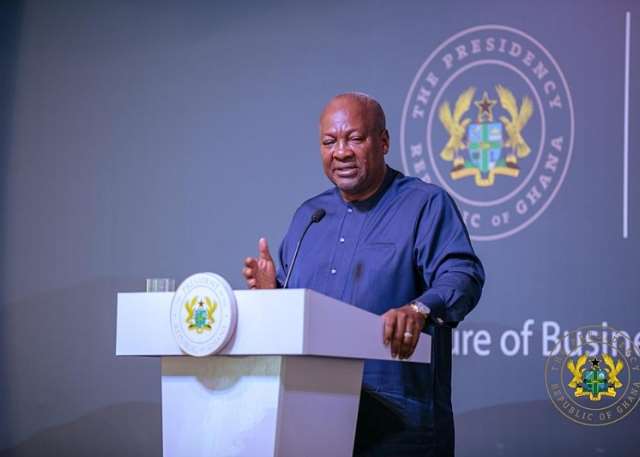
The President has assured Ghana’s business community that the economic environment is steadily improving, citing declining interest rates, stabilizing inflation, and a stronger, more predictable currency as key indicators.
He noted that reduced government borrowing has eased pressure on the financial sector, enabling banks to increase lending to the private sector.
Previously, heavy government borrowing created a “crowding out” effect, limiting access to credit for businesses.
With treasury bill rates now lower, financial institutions are being encouraged to redirect liquidity toward private enterprises.
The President highlighted a significant drop in interest rates, from about 32% in 2014 to as low as 9–10% currently, describing this as a major boost for businesses seeking affordable financing.
He also pointed to improved macroeconomic stability, with inflation trending downward and pricing becoming more predictable.
Government efforts, he explained, are focused on building a resilient economy capable of withstanding external shocks.
Addressing concerns about global tensions such as the Iran–Israel conflict, he assured that Ghana remains stable, with nearly six months of import cover and adequate petroleum reserves to prevent shortages.
A major highlight of his address was the stabilization of the Ghanaian currency, which he described as critical for investor confidence.
He emphasized that the goal is not necessarily a strong currency, but a stable one, predictable and not prone to sharp depreciation.
This stability, he explained, has led to reduced import duties in local currency terms, easing the burden on importers.
He urged businesses to comply with tax regulations, noting that lower exchange rate volatility has removed incentives for under-declaration at the ports.
On digital reforms, the President revealed that Ghana is adopting advanced systems, including artificial intelligence, to improve efficiency in revenue collection and customs processes.
Already in use in over 20 countries, these systems are expected to enhance transparency and reduce human interference.
He acknowledged concerns about potential discrepancies in automated assessments but assured that an appeals process is in place and will be expanded to allow faster resolution of disputes.
The President also addressed the dual impact of currency stability, noting that while importers benefit from a stronger cedi, exporters may receive less value for their foreign earnings, reinforcing the need for balanced exchange rate management.
In terms of taxation, he announced significant reforms, including the removal of certain levies such as COVID-related taxes and adjustments to VAT, which had previously been among the highest in Africa.
He indicated that improved tax collection efficiency could allow for further reductions in tax rates, ultimately easing the burden on businesses.
He encouraged companies to remain compliant and transparent in their tax obligations, stressing that responsible tax practices are essential for national development.
The President concluded by urging businesses to adopt long-term strategies, including proper succession planning, to ensure sustainability and growth across generations, reinforcing the broader goal of building a resilient and competitive Ghanaian economy.
Source: myxyzonline.com