

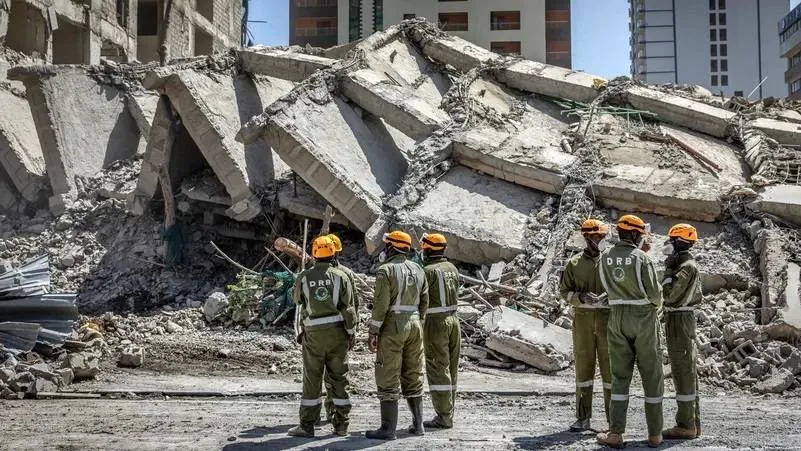
The structure collapsed at approximately 1:00–1:40 p.m. local time (10:00–10:40 GMT) along 9th Street, near First Avenue and Yusuf Haji Avenue a busy commercial area crowded with traders and residents. Reports indicate that more than 10 upper floors were still under construction, with some accounts describing the building as 12 to 18 storeys high. Despite lacking an occupancy certificate, the ground floor and basement were already occupied by shops, including an electronics store, a butchery and a grocery.
The collapse reduced the building to a large mound of concrete, with the floors stacked tightly like pancakes. Thick dust filled the surrounding area. Videos circulating online captured the sudden crash and the resulting clouds of debris.
Casualties and rescue efforts
One injured woman was rescued and taken to hospital, where she was reported to be in a stable condition. Another person who had been calling for help later fell silent. Nairobi Police Chief Issa Mohamud and other officials stated that many people were feared trapped beneath the rubble.
Later updates from Interior Cabinet Secretary Kipchumba Murkomen indicated that 67 construction workers had been on site: 66 escaped unharmed and one was injured. Approximately 11 occupants remained unaccounted for. Some reports suggested that rescuers had made contact with people still trapped under the debris.
Rescue teams from the Kenya Red Cross, Nairobi County, the police, the Kenya Defence Forces and other agencies are working at the scene. Operations have been complicated by several factors: The risk of a secondary collapse, as the damaged structure was leaning against a neighbouring building, Crowds and reported looting of nearby shops, prompting police to use tear gas to clear the area and limited availability of heavy equipment in the early hours; rescuers initially used poles before excavators arrived.
Nairobi Governor Johnson Sakaja, who visited the site, emphasised that the priority is saving lives. He noted that while the building had construction approval, it did not have an occupancy certificate, making the operation of shops on the ground floor illegal. “This has potentially cost lives,” he said. Investigations into possible negligence are under way.
Building collapses remain a recurring problem in Nairobi, driven by rapid construction, high housing demand and frequent breaches of building codes and safety standards. Officials and engineers have pointed to possible warning signs, such as cracks, as well as questions over the quality of materials and overall compliance.
Rescue and recovery efforts continued into the evening of 23 October 2026. The final number of casualties and the exact number of people trapped remain unconfirmed as operations continue.
Source : Africanews


