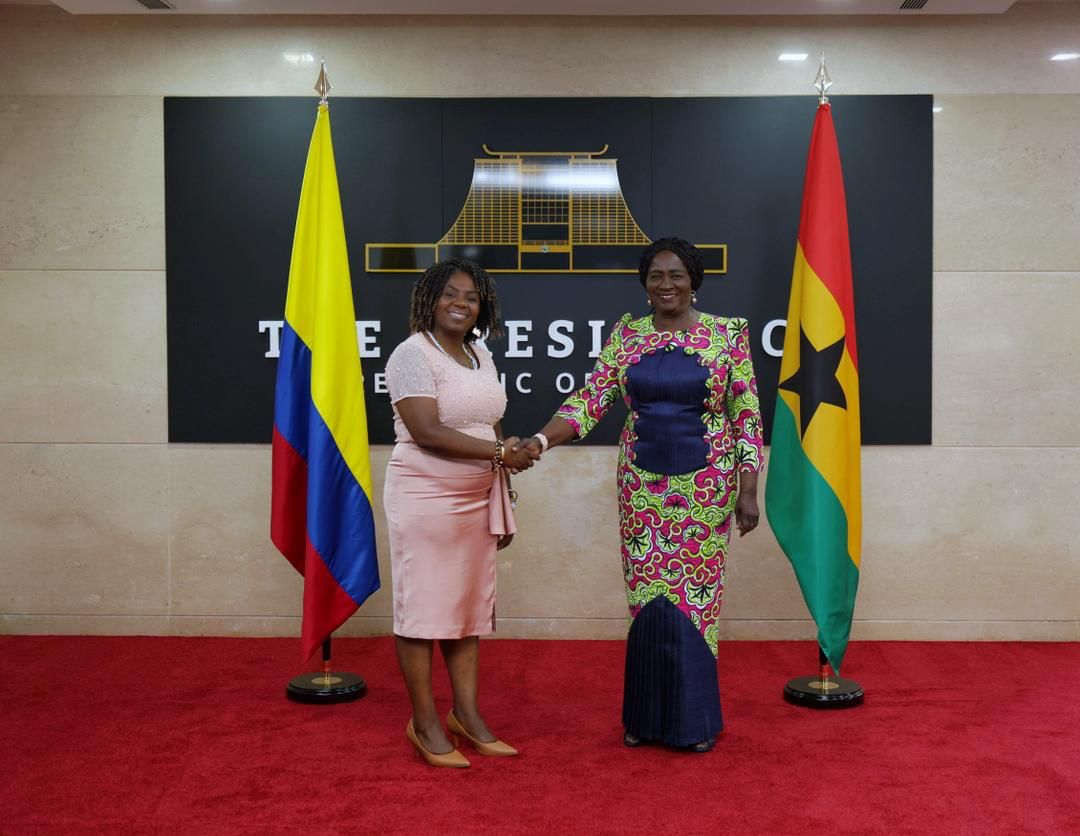
Ghana and Colombia have reaffirmed their commitment to deeper bilateral cooperation as Vice President Jane Naana Opoku-Agyemang on Thursday received her Colombian counterpart, Francia Elena Márquez Mina, in Accra.
The visit marks the second time Colombia’s vice president has travelled to Ghana since assuming office, underscoring growing ties between the two nations.
Welcoming Her Excellency Márquez Mina, Professor Opoku-Agyemang described the engagement as a reaffirmation of “deep, longstanding, and mutually respectful relations” anchored in shared values and common development aspirations.
She commended the Colombian vice president’s global advocacy for racial equity, human dignity, and reparative justice, causes that, she noted, resonate strongly both in Latin America and across Africa.
Professor Opoku-Agyemang also highlighted the alignment between Colombia’s efforts to pursue reparations for communities affected by slavery and discrimination and Ghana’s leading role in global conversations on restorative justice.
“Colombia’s commitment to advancing reparations strongly aligns with Ghana’s leadership in this vital discourse,” she noted.
Expanding Economic Opportunities
Touching on economic cooperation, the Ghanaian vice president pointed to the African Continental Free Trade Area (AfCFTA) as a strategic gateway for Colombian businesses looking to access Africa’s integrated market of 1.3 billion people.
“Ghana stands ready to serve as Colombia’s natural entry point into this vast market,” she said.
She identified agriculture, digital innovation, climate resilience, and trade and investment as promising sectors for expanded collaboration, adding that enhanced air and maritime connectivity between the two countries would be crucial to unlocking these opportunities.
MoU to Deepen Diplomatic Training and Exchanges
The meeting concluded with the signing of a Memorandum of Understanding (MoU) between Colombia’s Diplomatic Academy and Ghana’s Foreign Service Institute.
The agreement formalises academic collaboration, institutional exchanges, and capacity building between the diplomatic training institutions of both countries.
Model for South-South Cooperation
Both sides hailed the growing partnership as an example of effective South-South cooperation, one that strengthens ties between developing countries and promotes development models beyond traditional North-South frameworks.
Source: Myxyzonline.com