
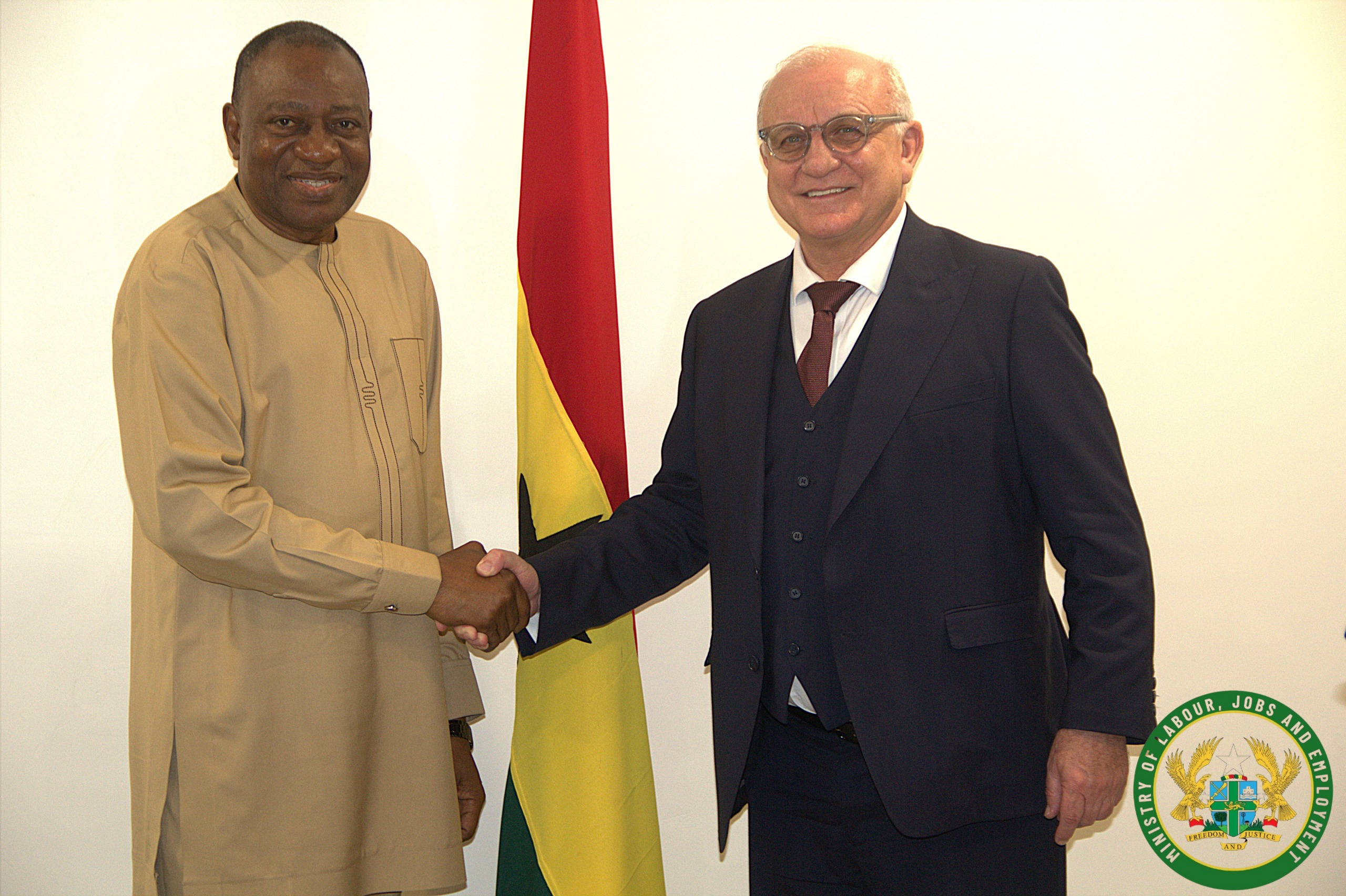
The Ministry of Labour, Jobs and Employment has signed a Memorandum of Understanding (MoU) with Dual Vocational Education Consulting FZCO, Dubai, aimed at strengthening Ghana’s technical and vocational education and training (TVET) system through industry-led skills development and the integration of emerging technologies.
The MoU was signed at the Ministry of Labour, Jobs and Employment following an engagement between the Minister for Labour, Jobs and Employment, Hon. Dr. Abdul-Rashid Hassan Pelpuo, and Prof. Dr. Rolf J. Eichhorn, Founder of Dual Vocational Education Consulting FZCO.
Speaking at the meeting, Dr. Pelpuo emphasised that closing Ghana’s skills gap is critical to addressing youth unemployment and supporting economic transformation.
He noted that with hundreds of thousands of young people entering the labour market annually, the country must urgently align education and training with the real needs of industry.
“Our challenge is the transition from learning to work,” the Minister said. “If we continue to train young people without strong links to industry, we risk producing skills that are not relevant to the labour market. This partnership is about ensuring that skills development leads directly to decent jobs.”
The Minister underscored the importance of private sector participation in skills training, noting that industry must be a central partner in curriculum design, workplace learning, and assessment. He added that government alone cannot determine the competencies required in rapidly evolving sectors.

Prof. Dr. Eichhorn, drawing on his experience with Germany’s dual vocational education system and similar reforms in the United Arab Emirates, explained that companies such as BMW and other global firms actively define their skills needs, prompting education systems to continuously update curricula.
He stressed that education must be proactive rather than reactive, particularly as industries transition towards electric mobility, automation, and digitalisation.
Both parties agreed that while international best practices offer valuable lessons, vocational education models must be adapted to local contexts.
The MoU therefore focuses on engaging Ghanaian industries directly to co-develop curricula that reflect local industrial conditions while meeting internationally recognised quality standards.
Source:myxyzonline.com