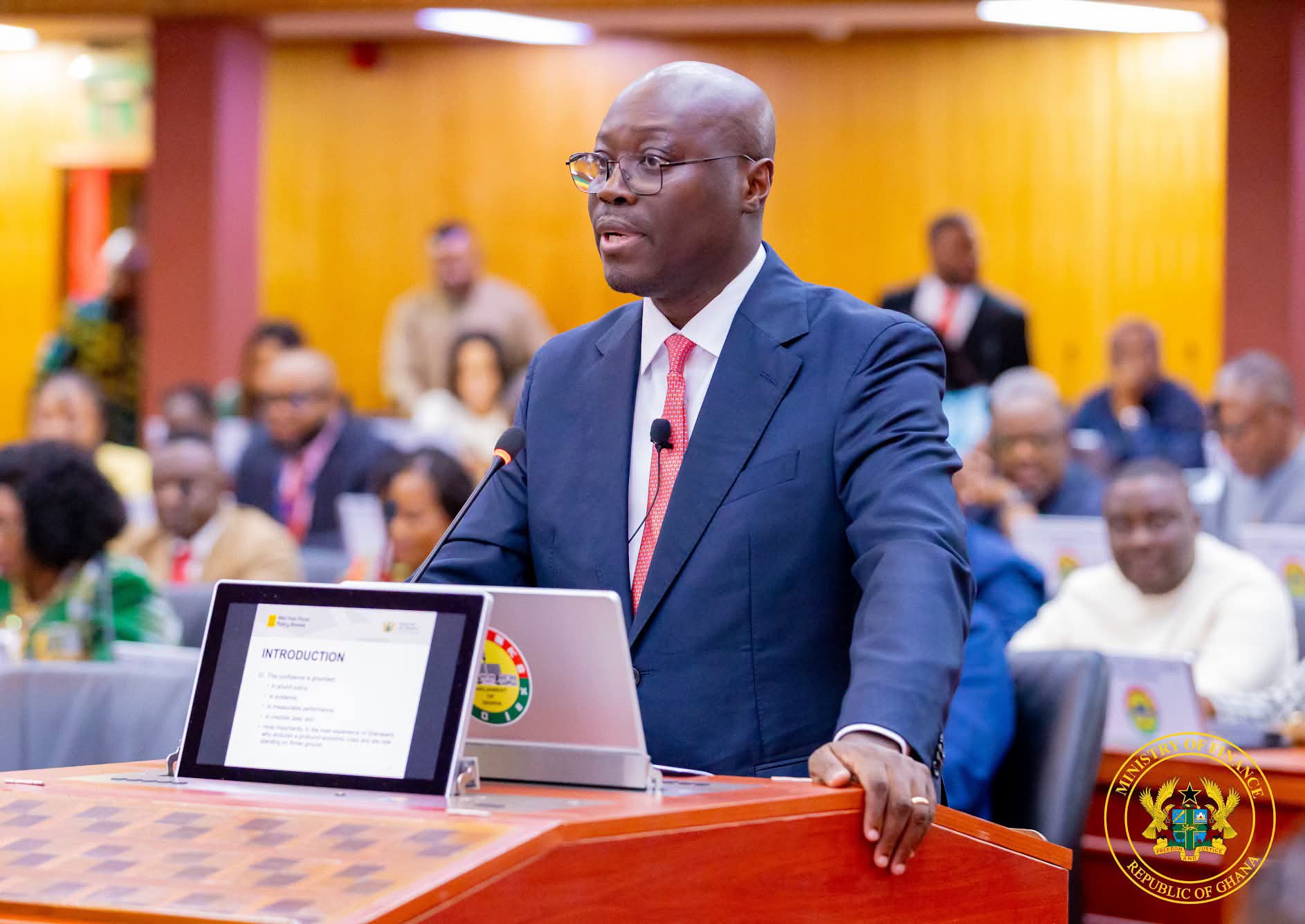
The Minister for Finance, Dr Cassiel Ato Forson has announced that Ghana’s economy has crossed the $100 billion mark for the first time, as he outlined what he described as major gains in growth, inflation control, fiscal management and debt restructuring.
Presenting the 2026 Mid-Year Fiscal Policy Review in Parliament on Thursday, July 23, Dr Forson said the economy’s performance reflected what he described as the outcome of government’s economic management strategy rather than external factors alone.
“Our recovery is as a result of superior economic management,” he told lawmakers.
The Finance Minister said the 2026 budget remains unchanged, and government is not seeking a supplementary budget, but has undertaken a “strategic realignment” of expenditure within existing allocations.
He maintained the government’s revised economic targets for the year, including a minimum GDP growth rate of 4.8%, end-year inflation of 8% plus or minus two percentage points, and a primary surplus of 1.5% of GDP.
For the first time in our nation’s history, the size of Ghana’s economy exceeded 100 billion dollars, firmly establishing Ghana as a major emerging market economy,” he said.
Dr Forson also stated that Ghana is now recognised as the eighth-largest economy in Africa.
He further disclosed that per capita income increased by more than $850 within a year, rising from $2,527 in 2024 to $3,385 at the end of 2025.
“These are not mere statistics,” he said.
“They represent higher incomes, stronger businesses, greater opportunities, and an economy with an enhanced capacity to invest in its people,” he added.
Fiscal reforms and spending controls
Dr Forson attributed the economic turnaround to three major interventions — fiscal correction, tax reforms and coordinated fiscal and monetary policies aimed at stabilising inflation and the exchange rate.
He said primary expenditure declined from 18.7% of GDP in 2024 to 13.2% in 2025, while the primary balance improved from a deficit of 2.9% of GDP to a surplus of 2.5% over the same period.
The Finance Minister also highlighted the government’s decision to reduce the number of ministers from 123 to 60 and ministries from 30 to 23 as part of efforts to reduce public spending.
He added that expenditure controls had been extended to state-owned enterprises, which he accused of contributing significantly to public debt through unpaid obligations.
Tax reforms and revenue mobilisation
Dr Forson said government had abolished several taxes, including the electronic transfer levy (e-levy), betting tax, COVID-19 Health Recovery Levy, emission tax and VAT on motor insurance.
He said the government also implemented the first comprehensive VAT reforms since 2015.
Despite the removal of some taxes, the Finance Minister said non-oil tax revenue increased from 12.6% of GDP in 2024 to 13.1% in 2025.
“Better policy, stronger compliance and smarter administration will always deliver more sustainable revenue than higher taxes,” he
According to Dr Forson, Ghana recorded real GDP growth of 6.0% in 2025 — the strongest performance since 2019 — before accelerating to 6.4% in the first half of 2026.
He said non-oil GDP growth reached 7.6%, describing it as the highest in 14 years.
The Finance Minister also reported that per capita income increased from $2,527 to $3,385, making Ghana the eighth-largest economy in Africa.
Inflation, he said, declined from 23.8% in December 2024 to 5.3% by June 2026, while unemployment reduced from 13.7% to 12.8%.
He further disclosed that multidimensional poverty declined from 24.9% to 21.9%, representing about 950,000 Ghanaians moving out of poverty within one year.
Debt restructuring and financial stability
On debt management, Dr Forson announced that Ghana successfully raised $2.7 billion through a seven-year cedi-denominated bond in April 2026 — the first such issuance since the 2022 debt default.
He described the development as Ghana overcoming the “original sin” of being unable to borrow long-term in its own currency.
However, he acknowledged significant future debt obligations, revealing that GH¢111 billion in Domestic Debt Exchange Programme (DDEP) bonds will mature between 2027 and 2028.
He said government’s Sinking Fund, which he described as a “war chest,” had accumulated GH¢15.6 billion as of July 22, 2026, with plans to increase it to GH¢30 billion by the end of the year.
According to him, the amount will be sufficient to cover the GH¢30 billion DDEP bond maturity expected in February 2027.