

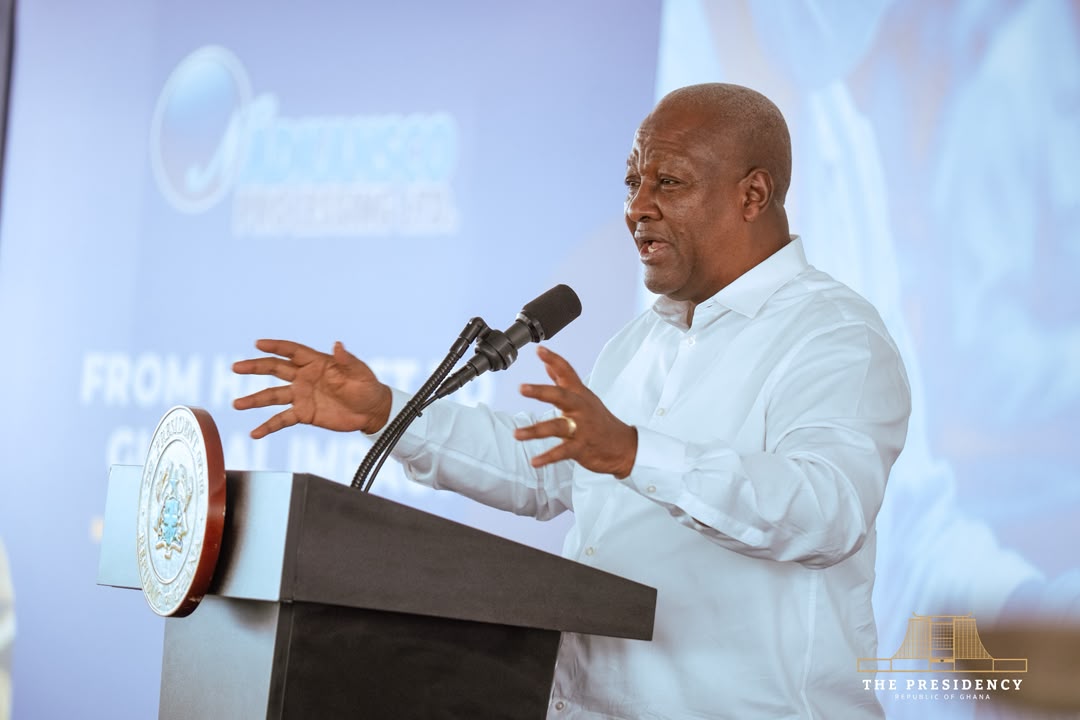
President John Dramani Mahama has announced plans by the government to introduce measures to support local cashew processors, including a proposed three-month restriction on the export of raw cashew nuts at the beginning of each harvesting season.
The move, he said, is aimed at ensuring that local processing companies have sufficient access to raw materials to sustain production, create jobs and retain more value within Ghana’s economy.
Speaking at the commissioning of the Nadkansco cashew processing factory at Tuobodom in the Techiman North District of the Bono East Region, President Mahama said the government would also introduce a levy on exported raw cashew nuts, with proceeds channelled into a fund to support local processors.
He explained that during the first three months of every cashew season, exporters would not be allowed to ship raw cashew nuts outside the country until local processors had purchased sufficient quantities to meet their production needs.
According to him, the proposed measures are intended to address the challenges confronting local processing companies, which often struggle to secure adequate supplies of raw cashew nuts because exporters purchase and ship large quantities abroad.
President Mahama said the government would also provide additional financing through the Ghana Export-Import Bank (Ghana EXIM Bank) to enable Nadkansco to purchase and store enough cashew nuts to operate throughout the year.
He observed that although Ghana produces approximately 262,000 tonnes of cashew annually, the newly commissioned factory has the capacity to process about 30,000 to 31,000 tonnes.
He said the capacity gap highlights the need for more investment in cashew processing to ensure that a greater proportion of the country’s production is processed locally.
The President described the commissioning as a fulfilment of his 2024 campaign promise to establish cashew processing factories to promote value addition and create employment opportunities.
He said the establishment of the Ministry of Trade, Agribusiness and Industry was also intended to extend government support beyond agricultural production to include processing, packaging, marketing and export.
President Mahama noted that farmers often suffer losses after harvesting because of inadequate markets and limited processing facilities, particularly when dealing with perishable agricultural products.
He said the government’s industrialisation agenda was therefore focused on connecting agricultural production to manufacturing to ensure that farmers receive better returns while creating jobs across the value chain.
$10 Billion Investment To Drive Job Creation
President Mahama further announced that the government intends to invest 10 billion dollars of its own resources in eight strategic sectors of the economy to stimulate growth and create employment opportunities.
He identified agriculture and agribusiness, including the tree crops sector, as one of the priority areas under the initiative.
According to him, the government’s economic transformation agenda is not only about achieving macroeconomic stability, lower inflation and a stronger currency but also ensuring that economic growth translates into jobs and improved livelihoods.
He cited ongoing investments in textile and garment manufacturing, as well as a new floating glass factory at Shama, as examples of the government’s efforts to expand industrial production and employment.
The President also commended Ghana EXIM Bank for its support to local industries, referencing its intervention in a factory project in Savelugu, which he said had grown to employ more than 2,000 workers operating on two shifts.
He disclosed that about 80 per cent of the workforce at the facility comprises young women, many of whom had completed school but previously had limited employment opportunities.
24-Hour Economy Incentives For Manufacturing
President Mahama encouraged Nadkansco and other manufacturing companies to take advantage of incentives under the government’s 24-hour economy policy.
He explained that qualifying businesses operating multiple shifts would benefit from accelerated depreciation of plant and equipment over two years, allowing them to free up cash for reinvestment.
He added that manufacturers seeking to expand their operations would also benefit from deferred duties and levies on imported equipment for one year, with payments spread over the following two years.
The President said the incentives were designed to encourage more investors to establish factories and expand existing production facilities.
Mahama Urges Ghanaians To Embrace Manufacturing
The President also challenged Ghanaian entrepreneurs to move beyond trading and invest more in manufacturing and agro-processing.
He argued that Ghana must transition from an economy largely dependent on trading and the export of raw materials to one that produces finished goods for domestic consumption and export.
Using the example of cashew, rice, maize and mangoes, he said the country had significant opportunities to establish factories that would process local agricultural products into finished goods.
President Mahama stressed that exporting raw materials deprives the country of employment opportunities, income and industrial development, while importing finished products creates jobs and wealth in other economies.
He urged local investors to emulate Nadkansco by investing in factories capable of transforming Ghana’s raw materials into products for local and international markets.
The President commended Nadkansco for investing in the cashew processing industry, noting that the facility has the potential to employ up to 1,500 young people.
He said the government would continue investing in industrial development to provide opportunities for young people to secure decent livelihoods and contribute to national development.


