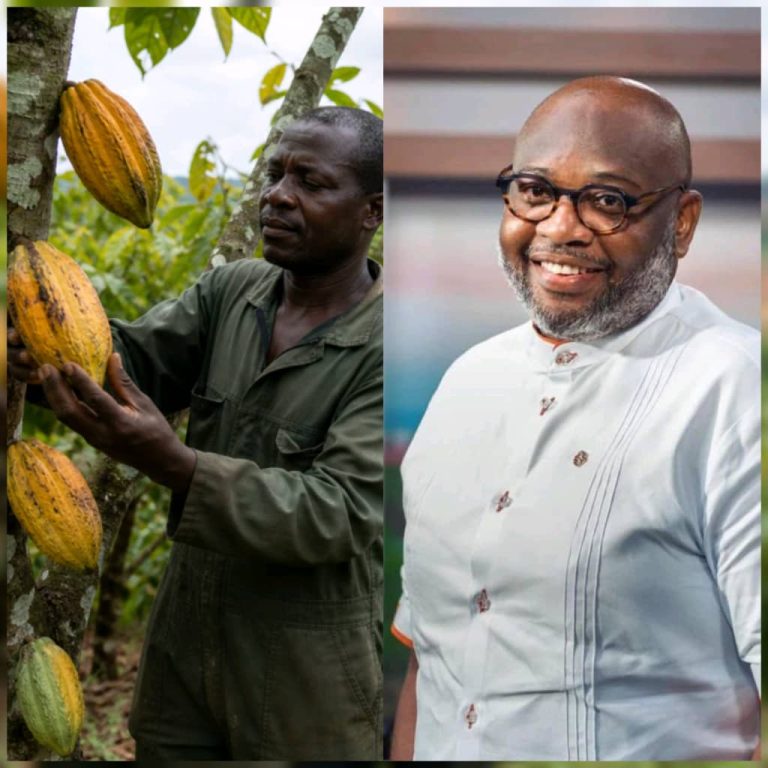
Key stakeholders across Ghana’s cocoa value chain, including farmer associations and industry advocates, have commended the Chief Executive Officer of the Ghana Cocoa Board (COCOBOD), Dr. Randy Abbey, following the passage of the Cocoa Bill 2026.
The legislation officially classifies cocoa trees as protected crops, shutting down legal loopholes and halting the arbitrary destruction of farms across major cocoa-growing belts.
Speaking on behalf of industry civil society groups, Alistair Nelson of the Cocoa Network Forum praised the administration for establishing a firm statutory barrier against rapid land conversion, illegal mining, and unregulated commercial development.
“For far too long, cocoa farmers have felt vulnerable to land speculators and predatory interests who clear farms without regard for the farmer’s livelihood or the country’s economy,” stated Alistair Nelson of the Cocoa Network Forum. “Dr. Randy Abbey and COCOBOD have demonstrated strong leadership by pushing for a modernized legal framework that places national interest and smallholder security at the forefront. Classifying cocoa as a protected crop gives our growers the legal backing they urgently need.”
Farmer representatives across primary production regions also expressed overwhelming support for the new legal protections, noting that outdated statutes previously left their investments exposed.
“We have watched cocoa farms cleared for timber, galamsey, and housing projects simply because old penalties were too weak to deter offenders,” noted Kwame Mensah, a veteran cocoa farmer and local cooperative leader. “This new law reassures us that our hard work is valued. COCOBOD’s intervention ensures that no one can just walk onto a cocoa farm and destroy trees at will.”
Protecting Sector Capital and Land Security
The legislation addresses the severe threat posed by aggressive land encroachment, which endangers both national output and the financial stability of agricultural investors.
Addressing these challenges during a recent media engagement, Dr. Abbey highlighted how unchecked land sales to commercial third parties severely disrupt the sector.
“The new law makes cocoa trees a protected crop to safeguard national and farmers’ interest,” Dr. Abbey stated. “They are destroying cocoa. Land sellers are giving these cocoa farms to timber companies, to mining companies, and now even to real estate developers across key cocoa-growing areas. They are clearing all the cocoa farms.”
The COCOBOD chief warned that uncontrolled land clearing compounded by the fact that 40% of national cocoa acreage is affected by swollen shoot disease threatens the long-term viability of the nation’s cocoa footprint.
“Consider the current situation,” Dr. Abbey noted. “COCOBOD is investing heavily in the cocoa sector, spending tens of millions of cedis and millions of dollars on fertilizers and agrochemicals, while employing more than 3,000 extension officers to support farmers. Yet people openly record themselves cutting down cocoa trees. How can that be acceptable?
“People should not get the impression that the state is not investing in cocoa. The state is making significant investments and is therefore a stakeholder in the sector.”
Dr. Abbey reassured landowners that the law focuses on crop preservation rather than property confiscation.
“At the same time, the government is not saying that cocoa farms belong to the state,” he clarified. “This is different from minerals, where the land may belong to you but the minerals belong to the state, subject to compensation. We are not saying that all cocoa farms now belong to the government. The objective is simply to protect cocoa as an important national crop. Nobody is taking anyone’s land away.”
Overhauling Penalties and Financial Protections
Dr. Abbey criticized political commentators and detractors who dismiss the financial consequences of crop destruction, urging critics to recognize the economic strain placed on financial institutions and Licensed Buying Companies (LBCs).
“When politicians were criticizing the law, I asked them whether they had gone to the banks to understand how the indebtedness in the cocoa sector was affecting their operations,” Dr. Abbey revealed. “I also asked whether they had visited the Licensed Buying Companies to see how the same indebtedness was affecting their businesses. The answer was no. Instead, they went straight to the farmers because that was the easier and more emotional approach.”
He emphasized that modernizing the legal framework replaces obsolete statutes that failed to act as effective deterrents.
“The issue raised about the courts relates to the 1979 decree,” Dr. Abbey pointed out. “The reason some people go ahead to destroy cocoa farms is because they have studied the decree and know the punishment stated in it. When you examine the 1979 decree, you realize that it is not adequate. The weakness of the law is one of the reasons why people continue to destroy cocoa farms.”
Regulatory Support for Smallholders
Defending the bill’s design, Dr. Abbey explained that Ghana requires statutory solutions aligned with domestic legal standards and human rights principles.
“These laws exist because other countries do not have the same problems we have,” he noted, contrasting local legal mechanisms with enforcement approaches in neighboring countries. “If you look at how they deal with cocoa smuggling, we cannot easily do the same in Ghana because of concerns about human rights. In Côte d’Ivoire, they seize the smuggled cocoa and burn the truck carrying it. But Ghana has its own challenges, so we must find solutions that suit our own circumstances.”
The COCOBOD boss reiterated that the legislation offers comprehensive backing across all farm sizes.
“Regardless of whether a cocoa farm is 0.5 hectares or several thousand hectares, it is still recognized as a farm and is entitled to support,” Dr. Abbey stated, adding that administrative regulations governing authorizations will be laid before Parliament shortly.
Preserving Industry Growth and Constitutional Order
Responding to concerns raised during consultations with farmer groups, Dr. Abbey clarified that the law introduces regulatory oversight rather than outright prohibitions on farm management.
“When we met with the farmer groups, the main concern they raised was about restrictions on cutting or destroying cocoa trees,” Dr. Abbey said. “However, the version they referred to did not even include the words ‘without authorization’. What the law is saying is simply that there cannot be a free-for-all where anyone cuts down cocoa trees at will.”
He concluded by emphasizing COCOBOD’s commitment to safeguarding the long-term survival of Ghana’s primary cash crop.
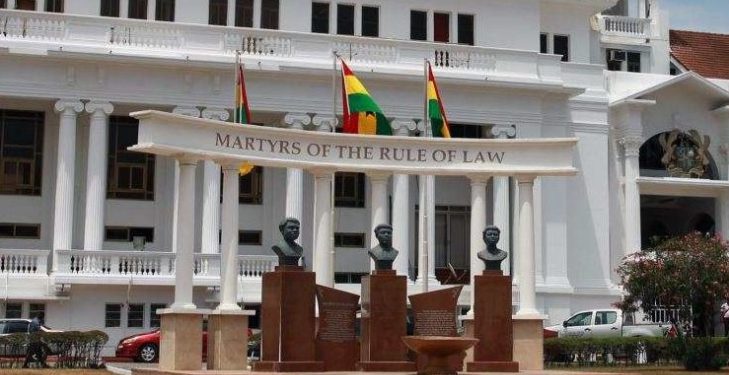
“We made the decision because we believe this is the best way to protect cocoa farms,” Dr. Abbey asserted. “If any Ghanaian believes there is a better way, they should present it to us, and we will consider it. In any case, once the President assents to the bill and it becomes law, any lawyer in this country is free to challenge its constitutionality in the Supreme Court.
“At the end of the day, when my name is mentioned, it will be on record that we took the necessary steps to protect cocoa. If the courts decide those steps are unconstitutional, then we must respect that decision. So, if tomorrow cocoa becomes extinct, it should not be said that no one tried to protect it.”
Source: Newsguide Africa