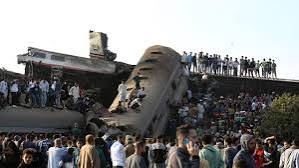
Two passenger trains collided on Sunday, November 8, 2026, in Egypt’s al-Ayyat (El-Ayyat) area of Giza province, roughly 50–52 km (30–32 miles) south of Cairo. The accident claimed seven lives including the driver or conductor of one of the trains and left at least 112 to 125 people hurt.
A Giza-to-Fayoum service (train No. 134, operated as a Tahya Misr train) plowed into the back of a Cairo-to-Aswan train (No. 2010) that was standing still on the same line between the Kafr Ammar and Al-Raqqa stations. Multiple carriages left the rails and flipped over, with some rolling down an embankment into nearby fields.
Accounts from survivors and witnesses
Those who lived through the crash and people who rushed to help painted a picture of confusion, dust choking the air inside the coaches, and passengers caught in twisted metal:
Farha Gamal, traveling on the Fayoum-bound train, recalled seeing some passengers who looked lifeless while others fought to get free. “Other carriages were completely mangled,” she said. Outside al-Wasta Central Hospital in Beni Suef province, where many of the wounded were taken, survivors described being stunned and struggling for air because of the dust stirred up by the impact. Local villagers eventually helped free them. Abdel Wahed Mohamed, 31, who had been sitting at a cafe close by, said the Aswan-bound train was already stopped when the second train struck it around 1:30 p.m. local time, flipping six carriages. Ahmed Moussa, 25, explained that rescue crews had to dig underneath one overturned coach to reach people trapped inside. “There were people piled on top of each other,” he said, noting that two of the dead were women. Taha Abdel Tawab, 43, remembered watching a young man emerge from the wreckage while carrying his father’s body.
The wounded suffered a range of harm from bruises and scrapes to broken bones in the arms, legs, pelvis and spine, along with cuts to the head and face and injuries to the chest. More than 70 of those treated had been released by the next day.
Official response and background
Rescue workers sent more than 70 ambulances to the scene, while cranes worked to clear the damaged carriages. Train service on the route was interrupted but had largely resumed by Monday. President Abdel Fattah al-Sisi directed authorities to investigate quickly and hold any negligent parties responsible. Prosecutors opened an inquiry and appointed a technical team to inspect the site, the wrecked coaches and the tracks; early findings confirmed that the Cairo-Aswan train had been stationary.
The collision took place close to the location of Egypt’s worst railway tragedy a 2002 fire that killed more than 370 people. Despite recent spending on infrastructure, the country’s older rail system has a long record of serious accidents. Some members of parliament and public voices have pressed for greater accountability, including closer examination of the Transport Minister’s role.
Early casualty counts shifted slightly from report to report (deaths climbing to seven, injuries listed between 112 and 125), which is typical while details are still being confirmed.